

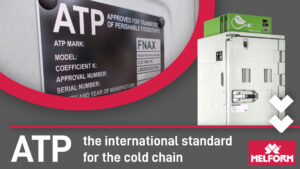
In the transport of perishable goods, temperature consistency is a critical factor.
ATP Certification (Accord Transport Perissable) is the international standard that defines thermal insulation and temperature control requirements for vehicles and containers intended for the cold chain.
This certification system ensures that food, pharmaceuticals, and other sensitive products are transported under controlled conditions, in compliance with international regulations.

What is the ATP agreement and what is it for?
The ATP Agreement is an international regulation that establishes measurable technical criteria for temperature-controlled transport. Its goal is to ensure that transport systems maintain their declared performance over time, reducing the risk of cargo deterioration.
ATP is applied in sectors such as:
- food logistics and food service
- catering and institutional food services
- pharmaceutical and medical sectors
- long-distance transport of perishable goods

The K-Coefficient in ATP certification
The K-coefficient measures the thermal insulation efficiency of an ATP-certified container or vehicle.
The lower the K-value, the greater the system’s ability to limit heat exchange with the external environment.
This value is determined exclusively through official tests performed by authorized ATP bodies according to standardized procedures.
ATP classification based on the K-coefficient
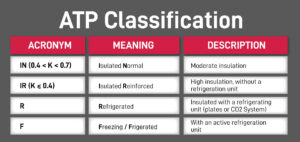

ATP Temperature Classes and Applications
In addition to insulation, the ATP Agreement defines the operating temperatures that a container or vehicle must be able to maintain.
- Class A: up to 0 °C – fresh food
- Class B: up to −10 °C – frozen products
- Class C: up to −20 °C – deep-frozen food
This classification allows you to select the most suitable solution based on the type of goods transported.


How to read ATP codes on containers
The ATP codes found on identification plates indicate the technical configuration of the system and the level of certified performance.
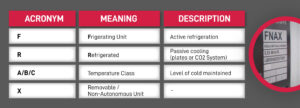
The correct interpretation of ATP codes is essential for assessing a container’s suitability for the required operating conditions.

Duration and renewal of ATP certification
ATP certification is only valid if issued by accredited testing centers following official inspections.
- Initial validity: 6 years
- Subsequent renewals: every 3 years
- Maximum total duration: 15 years, subject to passing verification tests
This system ensures that declared thermal performance remains verifiable over time.

MELFORM ATP-Certified Containers
MELFORM produces ATP-certified passive insulated containers, refrigerated containers, and active refrigerated containers intended for food logistics, the medical sector, and catering.
ATP certification represents a concrete guarantee of:
- certified thermal stability
- safety in the transport of sensitive goods
- compliance with international standards
In temperature-controlled transport, ATP certification is not a technical detail, but an objective criterion for quality and reliability.